Photo editing is one of the most important parts of modern visual communication. In today’s digital world, people see and judge images faster than ever before. A photograph can represent a brand, sell a product, capture a memory, tell a story, or shape a customer’s first impression within seconds. But a raw image is not always enough to create that impact. This is where photo editing becomes essential.
Photo editing is the process of improving, correcting, refining, or transforming an image using digital tools and techniques. It can involve simple tasks like adjusting brightness and contrast, or advanced work such as retouching skin, removing backgrounds, correcting colors, eliminating reflections, restoring damaged old photos, and preparing product images for professional marketing use.
In the simplest sense, photo editing helps an image look better. In a broader and more professional sense, it helps an image perform better. A professionally edited photo can make a product appear more attractive, a portrait look more polished, a property look more inviting, and a brand look more trustworthy. Whether the purpose is artistic, commercial, editorial, or personal, editing turns a good image into a stronger and more effective one.
Many people think photo editing is only about adding filters or making pictures look flashy. In reality, professional photo editing is a technical and creative discipline that combines visual judgment, brand consistency, precision, and storytelling. An expert photo editor does not simply “change” a picture. They improve its clarity, correct its flaws, enhance its strengths, and align it with a specific purpose.
This article explains what photo editing is in detail, how it works, why it matters, what types of photo editing exist, which industries depend on it, what tools professionals use, and how quality editing supports marketing, sales, branding, and communication. If you want a complete and professional understanding of photo editing, this guide covers everything you need to know.
What Is Photo Editing?
Photo editing is the process of modifying and enhancing a photograph after it has been captured. It includes any adjustment made to improve the final image, whether for visual appeal, technical correction, branding, storytelling, or commercial use.
A photograph taken by a camera is often only the starting point. Even high-quality cameras and skilled photographers cannot always produce the perfect final image straight out of the camera. Lighting may be slightly uneven, the color temperature may be inaccurate, the background may contain distractions, or the image may need resizing for a website, social media platform, printed brochure, or online store. Editing allows those issues to be corrected in a controlled and professional way.
Photo editing can be subtle or dramatic. In some cases, the editor only makes small improvements to preserve the natural look of the image. In other cases, the editor performs detailed transformations to create a polished commercial result. The level of editing depends on the image’s purpose, target audience, and required output.
For example, a wedding photo might need gentle retouching and color balancing to look elegant and timeless. A product photo for eCommerce may require background removal, shadow creation, and color accuracy so that the item appears clean and consistent across an entire online catalog. A real estate image may need perspective correction and brightness enhancement to make the interior look spacious and welcoming. A fashion image may need high-end skin retouching, color grading, and garment refinement for advertising.
At its core, photo editing is about improving image quality and presentation. It ensures that the final image matches the visual intention behind it.
The Main Purpose of Photo Editing
The main purpose of photo editing is to improve an image so it communicates more clearly, looks more professional, and better serves its intended use.

A photo can have many different purposes. It can be used to attract buyers, preserve memories, build a brand, support a campaign, tell a story, or strengthen visual identity. Editing helps the image fulfill that purpose more effectively.
One major purpose of photo editing is correction. Cameras do not always capture a scene exactly the way the human eye sees it. The photo may appear too dark, too bright, too warm, too cool, too flat, or too dull. Editing corrects these imbalances so the image becomes visually accurate and appealing.
Another purpose is enhancement. Even when a photo is technically acceptable, it may still need refinement. Editing can enhance sharpness, improve contrast, make colors more vibrant, and highlight the subject more clearly. These improvements help the image stand out without looking artificial.
Photo editing also serves a presentation purpose. Different platforms require different image formats, sizes, and visual styles. An image for Instagram, an eCommerce website, a magazine ad, and a billboard all need different preparation. Editing ensures that the same core image can be optimized for each use.
Beyond correction and enhancement, photo editing supports branding. Businesses need consistency in how their images look. A brand that uses clean, bright, premium-looking visuals creates a stronger and more reliable impression than one with inconsistent or poorly edited images. Editing helps maintain that visual standard across campaigns, products, websites, catalogs, and social media.
In short, the purpose of photo editing is not only to make photos attractive. It is to make them useful, effective, polished, and aligned with the intended message.
Why Photo Editing Is Important in the Digital Era
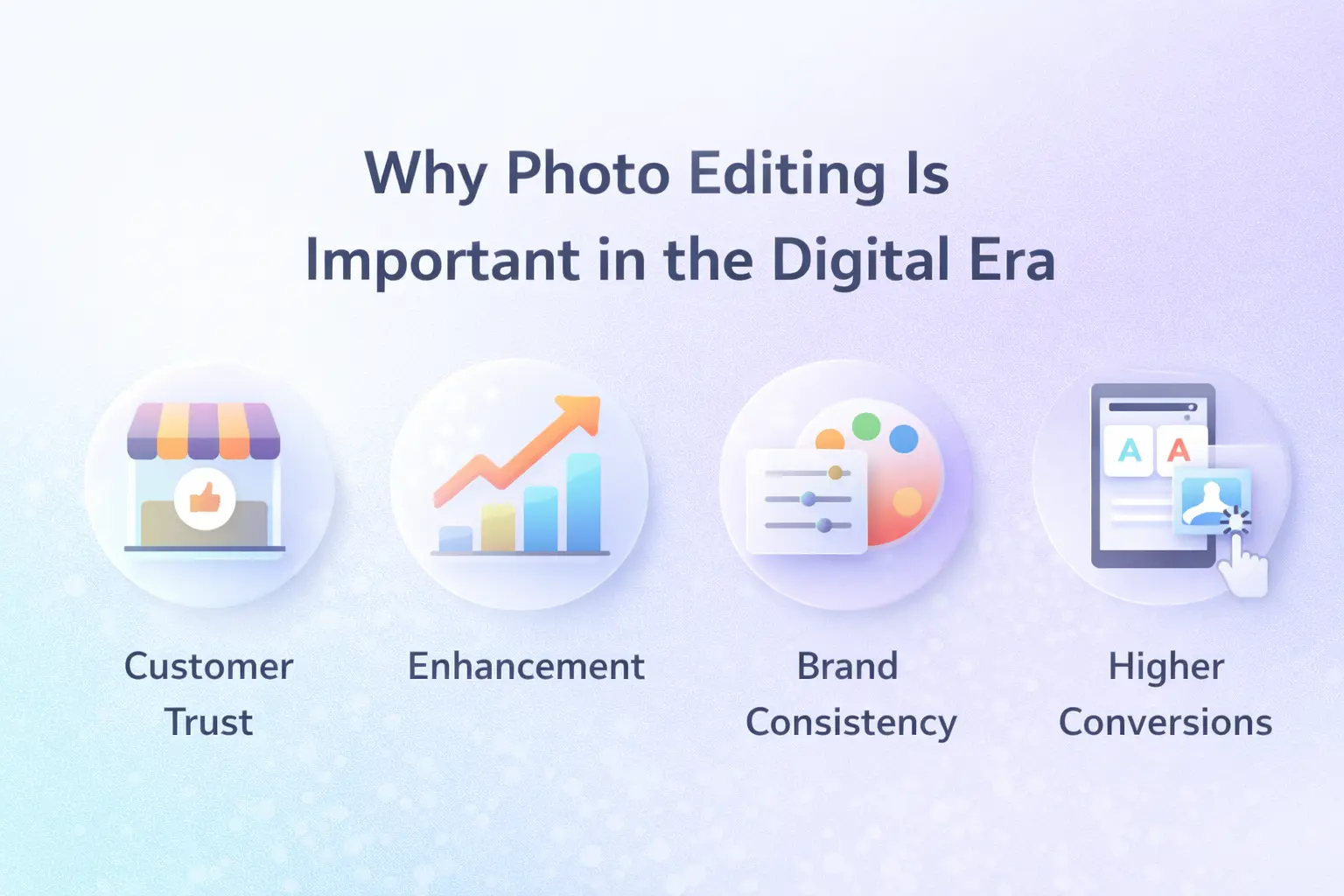
Photo editing is more important today than ever before because the modern world is highly visual. Businesses, influencers, media companies, online stores, and everyday users all compete for attention using images. In such an environment, image quality has direct influence on perception, trust, and response.
People often form an opinion about a product, service, or brand based on visual presentation before they read a single word. If the image looks low quality, cluttered, poorly lit, or unprofessional, the viewer may lose interest immediately. On the other hand, a clean and polished image can generate confidence, increase engagement, and encourage action.
For businesses, this is especially important. Product photography, advertising visuals, banners, social media posts, website images, and printed marketing materials all rely on strong image quality. An attractive visual can increase click-through rates, improve customer trust, and help convert visitors into buyers.
In eCommerce, photo editing is critical because customers cannot touch or inspect the product physically. They rely almost entirely on images to judge color, shape, texture, detail, and quality. If product images are inconsistent, poorly cropped, or visually weak, the business may lose sales. Professional editing helps create clean, accurate, and conversion-friendly product photos.
In branding, editing helps maintain a consistent visual language. It allows businesses to present their images in a way that supports their identity, whether luxurious, minimal, vibrant, natural, or bold. Consistency in color, tone, background, and style makes a brand look more professional and memorable.
In personal photography, editing helps preserve important moments beautifully. Family portraits, weddings, birthdays, travel images, and creative shoots often deserve that extra refinement to feel complete.
In the era of websites, smartphones, online shops, and social platforms, photo editing is no longer optional for quality-conscious communication. It has become a standard part of content creation and visual strategy.
How Photo Editing Works
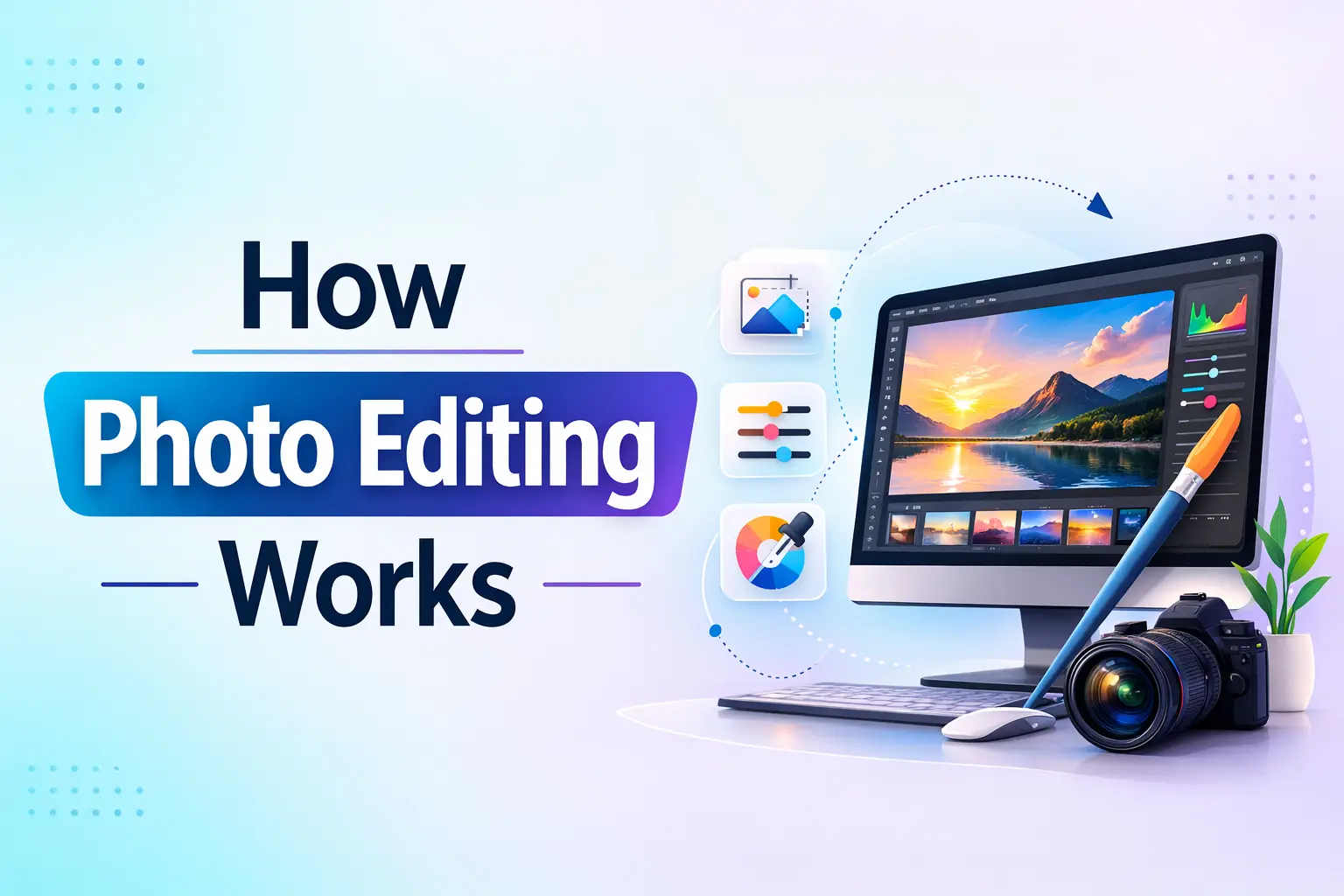
Photo editing works by applying controlled adjustments and modifications to a digital image. These changes are made using specialized software, where the editor can view the photo, identify areas that need improvement, and make precise corrections.
The process usually begins with image evaluation. The editor first examines the photo to understand its strengths and weaknesses. They look at exposure, white balance, shadows, highlights, composition, sharpness, background distractions, skin texture, reflections, product details, and overall visual balance.
After evaluation, the editor decides what kind of work is required. Some images only need global adjustments, such as correcting brightness, contrast, color temperature, and cropping. Others require local adjustments, where specific parts of the image are edited separately. For example, the background may need cleaning while the subject needs sharpening and color correction.
Professional editing often involves working with layers, masks, adjustment tools, and non-destructive workflows. A non-destructive workflow means the original image is preserved while edits are applied in a reversible way. This is important because it allows the editor to refine the image without permanently damaging the source file.
The editing process may include technical corrections first, followed by creative refinements. Technical corrections make the image accurate and clean. Creative refinements help shape mood, style, and visual impact.
Once the editing is complete, the file is exported in the correct format and dimensions for its final use. A high-resolution TIFF or PSD may be prepared for printing, while a compressed JPEG or WebP may be created for web use. If the image is for eCommerce, it may need a pure white background and specific pixel size. If it is for social media, it may need optimized proportions and file size.
In a professional environment, photo editing is both a technical workflow and a creative process. It combines precision, software knowledge, visual taste, and practical understanding of output requirements.
Common Types of Photo Editing
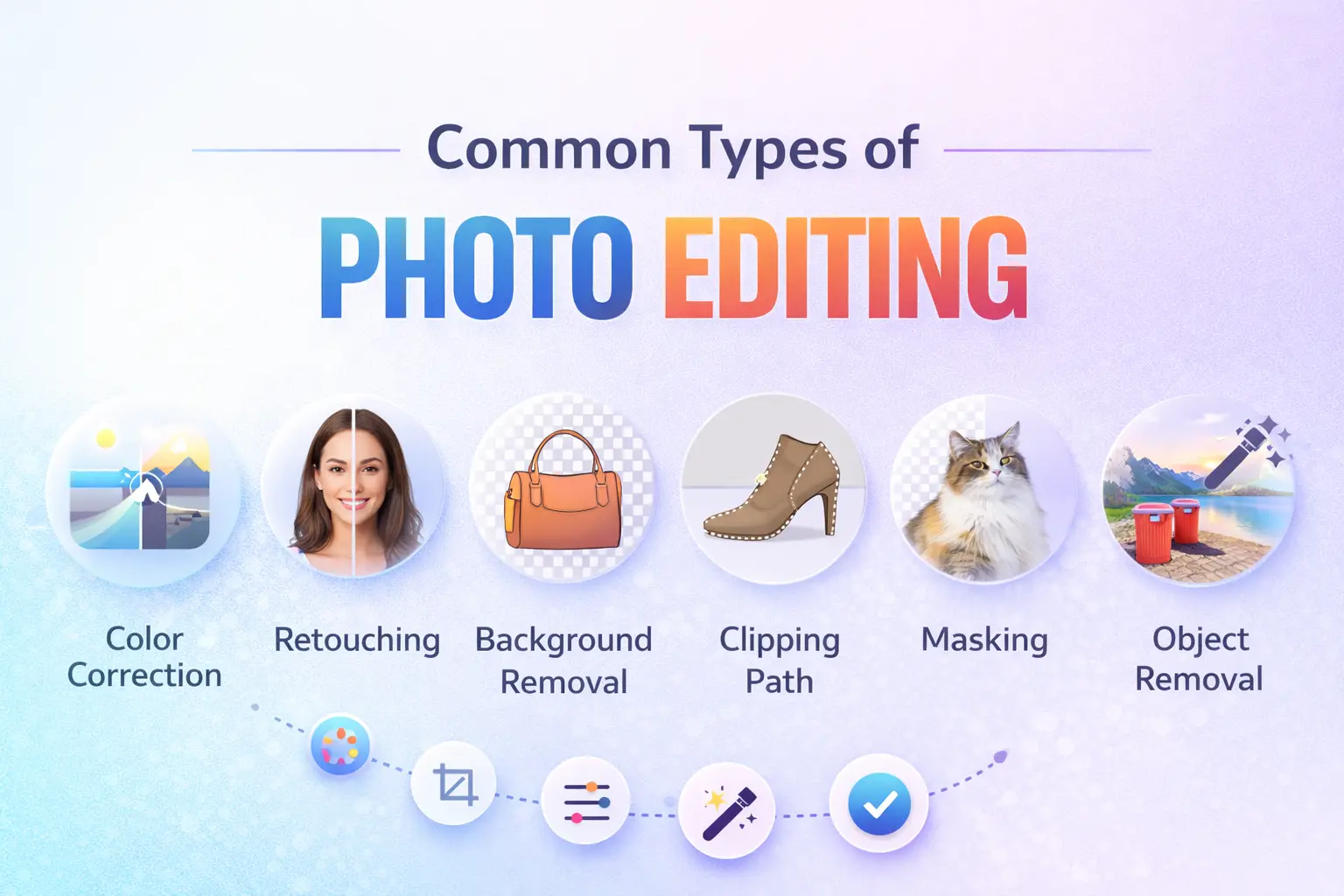
Photo editing is a broad field with many specialized techniques. Different images require different approaches depending on their purpose. Below are the most common types of photo editing used across industries.
Color Correction
Color correction is one of the most fundamental parts of editing. It adjusts the colors in a photo so they look natural, balanced, and visually accurate. Sometimes a photo may appear too yellow, too blue, too green, or too dull due to lighting conditions or camera settings. Color correction fixes these issues.
Editors adjust white balance, temperature, tint, saturation, vibrance, highlights, shadows, and tonal balance to improve the image. In product photography, color accuracy is especially important because customers expect the product color they see online to match what they receive in real life.
Exposure and Light Adjustment
A photo may be underexposed or overexposed. This means it may be too dark or too bright. Exposure editing corrects the overall light level of the image. Editors also fine-tune highlights, shadows, contrast, and midtones to restore detail and improve depth.
This type of editing helps the subject stand out and makes the image more visually pleasing. It is widely used in portraits, landscapes, interiors, product photos, and event photography.
Retouching
Retouching focuses on improving fine details. In portrait editing, retouching may include removing blemishes, softening skin, reducing under-eye shadows, cleaning stray hairs, whitening teeth slightly, refining makeup, or correcting distracting marks. Good retouching preserves natural texture while improving the overall appearance.
In product retouching, editors remove dust, scratches, wrinkles, stains, reflections, and imperfections from the item being photographed. The goal is to make the product look clean and premium without misleading the buyer.
Background Removal
Background removal is the process of separating the main subject from its original background. The subject can then be placed on a transparent background, pure white background, or any custom setting.
This is especially common in eCommerce, advertising, and catalog photography. Clean background removal helps products look neat, isolated, and consistent across a website or marketplace. It also makes layout design easier for banners and promotional materials.
Clipping Path
A clipping path is a precise editing technique used to cut out objects from their background using vector paths. It is ideal for products with sharp, defined edges such as shoes, bags, boxes, furniture, electronics, and cosmetics.
Clipping path services are widely used in professional product image editing because they provide clean cutouts and allow easy background replacement. This method is highly valued in online retail and print production.
Image Masking
Masking is used when a subject has soft, complex, or detailed edges that are difficult to isolate with a clipping path alone. Hair, fur, feathers, transparent fabric, smoke, and glass objects often require image masking.
Masking allows the editor to preserve fine edge details while removing or replacing the background accurately. It is a more advanced and flexible method than simple cutout techniques.
Shadow Creation and Reflection Editing
When a background is removed, the product may look flat unless realistic shadows are added. Editors create natural drop shadows, soft shadows, reflection shadows, or contact shadows to give depth and realism.
In some cases, the opposite is needed. Unwanted reflections on glass, chrome, metal, or glossy surfaces must be removed or reduced. Reflection editing is common in product photography, especially for jewelry, watches, electronics, and polished items.
Cropping and Resizing
Cropping improves composition by removing unnecessary parts of the image and focusing more strongly on the subject. Resizing prepares the image for specific formats such as website banners, online listings, print layouts, thumbnails, or social media posts.
Though simple, cropping and resizing are important because they affect how the image is viewed and how well it fits the platform.
Photo Manipulation
Photo manipulation involves combining, changing, or transforming image elements to create a conceptual or creative result. This can include adding or removing objects, changing backgrounds, compositing multiple images, creating surreal effects, or designing advertising visuals.
This is more creative and less corrective than standard editing. It is often used in posters, campaigns, cover art, and digital artwork.
Photo Restoration
Photo restoration is the process of repairing old, damaged, faded, torn, scratched, or discolored photographs. Editors restore detail, correct tones, rebuild missing parts, and improve clarity while preserving the historical or emotional value of the image.
This work is common for family archives, historical documents, memorial images, and vintage collections.
The Difference Between Photo Editing, Retouching, and Manipulation
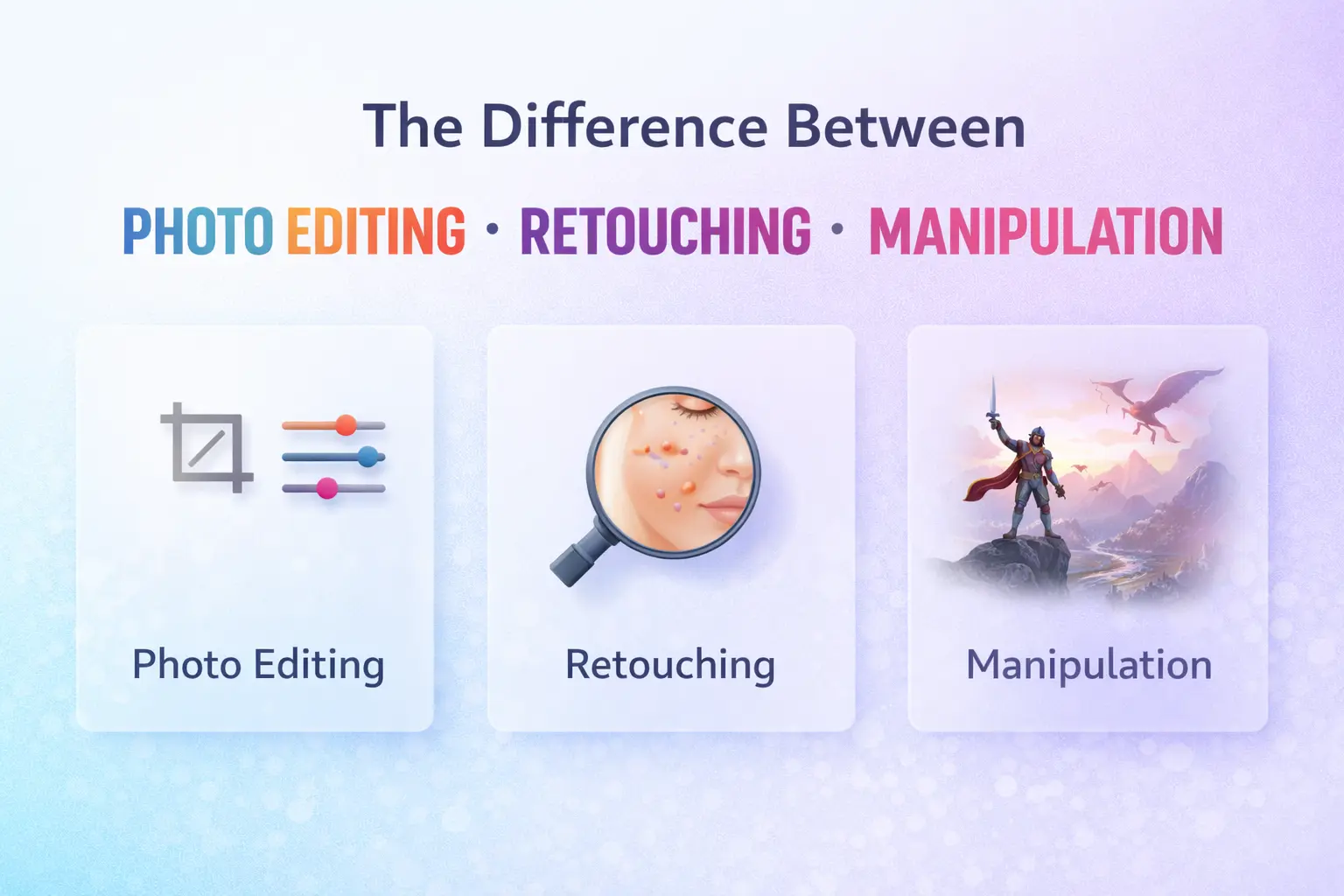
These terms are often used interchangeably, but they are not exactly the same.
Photo editing is the broad category. It includes all changes made to an image after it is captured. This can range from basic corrections to advanced refinements.
Retouching is a specific type of photo editing that focuses on detail improvement. It usually refers to cleaning imperfections, refining textures, improving skin, product surfaces, or visual polish while keeping the image realistic.
Manipulation goes further. It involves altering the image creatively or structurally. It may include changing the background, combining elements from multiple images, or creating a visual scene that did not exist originally.
For example, adjusting exposure on a portrait is photo editing. Removing blemishes and refining skin is retouching. Placing the person into a fantasy environment is manipulation.
Understanding this distinction is important because different projects require different levels of work. A corporate headshot might need light editing and retouching. A billboard campaign might require heavy manipulation. An eCommerce photo may need precise editing but not artistic manipulation.
Industries That Rely on Photo Editing
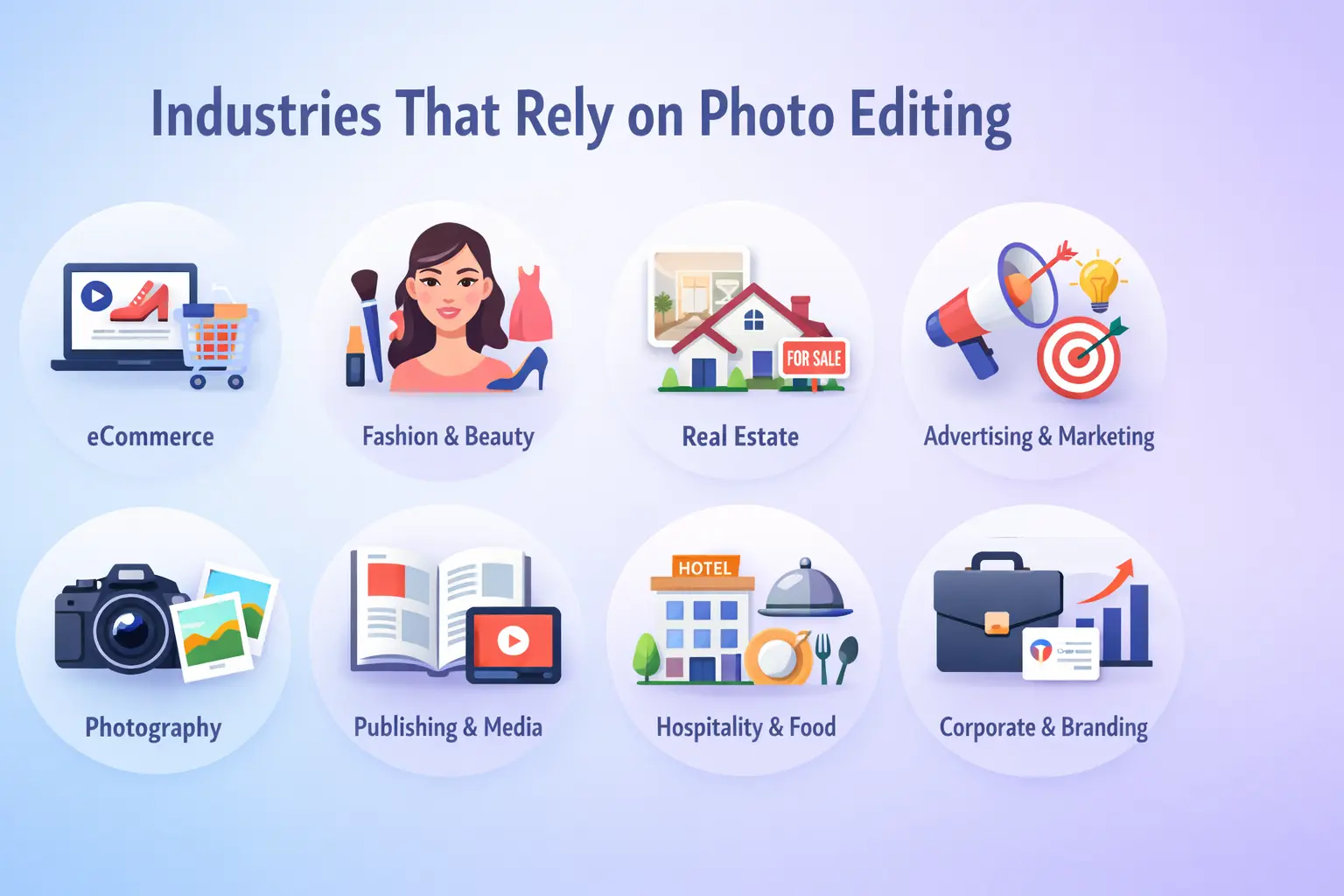
Photo editing is not limited to photographers or designers. It is a core service for many industries that depend on visual presentation.
eCommerce
Online retail is one of the biggest users of photo editing. Product images must be clean, consistent, sharp, and accurate. Background removal, clipping path, retouching, shadow creation, and color correction are standard for eCommerce businesses.
Because online shoppers cannot physically inspect products, edited images play a key role in purchase decisions. Better product visuals can directly improve trust and conversion rates.
Fashion and Beauty
Fashion brands use photo editing extensively for campaigns, lookbooks, model portfolios, social media posts, and eCommerce listings. Skin retouching, garment cleanup, color styling, and high-end polish are common.
Beauty brands also need close-up image perfection, especially for makeup, skincare, haircare, and model presentations.
Real Estate
Real estate photography depends on brightness correction, perspective alignment, object cleanup, sky replacement, and color balancing. These edits help interiors and exteriors look spacious, clean, and inviting.
Property listings with professionally edited images often attract more attention and inquiries.
Advertising and Marketing
Advertising visuals must be eye-catching, polished, and brand-consistent. Whether it is a social media ad, a website banner, a poster, or a product launch campaign, editing ensures the final image is compelling and high impact.
Marketing teams depend on photo editing to create content that performs well across multiple channels.
Photography Studios
Wedding photographers, portrait photographers, event photographers, and commercial photographers all rely on editing to complete their work. Editing is part of the final delivery. It ensures that the client receives refined, emotionally strong, and professionally finished images.
Publishing and Media
Magazines, newspapers, blogs, and online publications use edited photos to support articles and visual storytelling. Editorial images often require tonal adjustments, retouching, crop optimization, and layout preparation.
Hospitality and Food
Hotels, restaurants, resorts, and food brands use edited photos to present their spaces and products attractively. Food photography often needs color and texture enhancement to make dishes look fresh and delicious. Hospitality images must feel inviting and premium.
Corporate and Branding
Corporate websites, annual reports, presentations, team headshots, event recaps, and company profiles all benefit from professional editing. Businesses use refined images to look credible, organized, and modern.
Benefits of Professional Photo Editing
Professional photo editing offers many practical and strategic benefits.
One of the biggest benefits is improved visual quality. Editing makes images cleaner, sharper, brighter, and more balanced. This creates a stronger first impression.
Another major benefit is increased professionalism. A professionally edited image signals care, quality, and credibility. Whether it is a product listing or a company profile, polished visuals elevate perception.
Consistency is another important advantage. Professional editing ensures that a group of images looks unified in tone, lighting, color, crop, and overall style. This is essential for catalogs, online stores, social media feeds, and branded campaigns.
Editing also saves images that might otherwise be unusable. A slightly dark image, a background distraction, a skin imperfection, or a color issue can often be corrected successfully.
For businesses, edited images support better marketing performance. Strong visuals can lead to higher engagement, lower bounce rates, more trust, and better conversions. Customers are naturally drawn toward content that looks clear and premium.
Editing also helps tailor images for different platforms. The same photo can be prepared differently for print, web, mobile, ads, social media, or product marketplaces. This flexibility increases the usefulness of every shoot.
Finally, professional photo editing helps communicate value. A premium product presented with poor visuals may look cheap. A simple product presented with excellent visuals may look desirable. Editing influences how viewers interpret quality, price, and brand reputation.
Essential Techniques Used in Professional Photo Editing
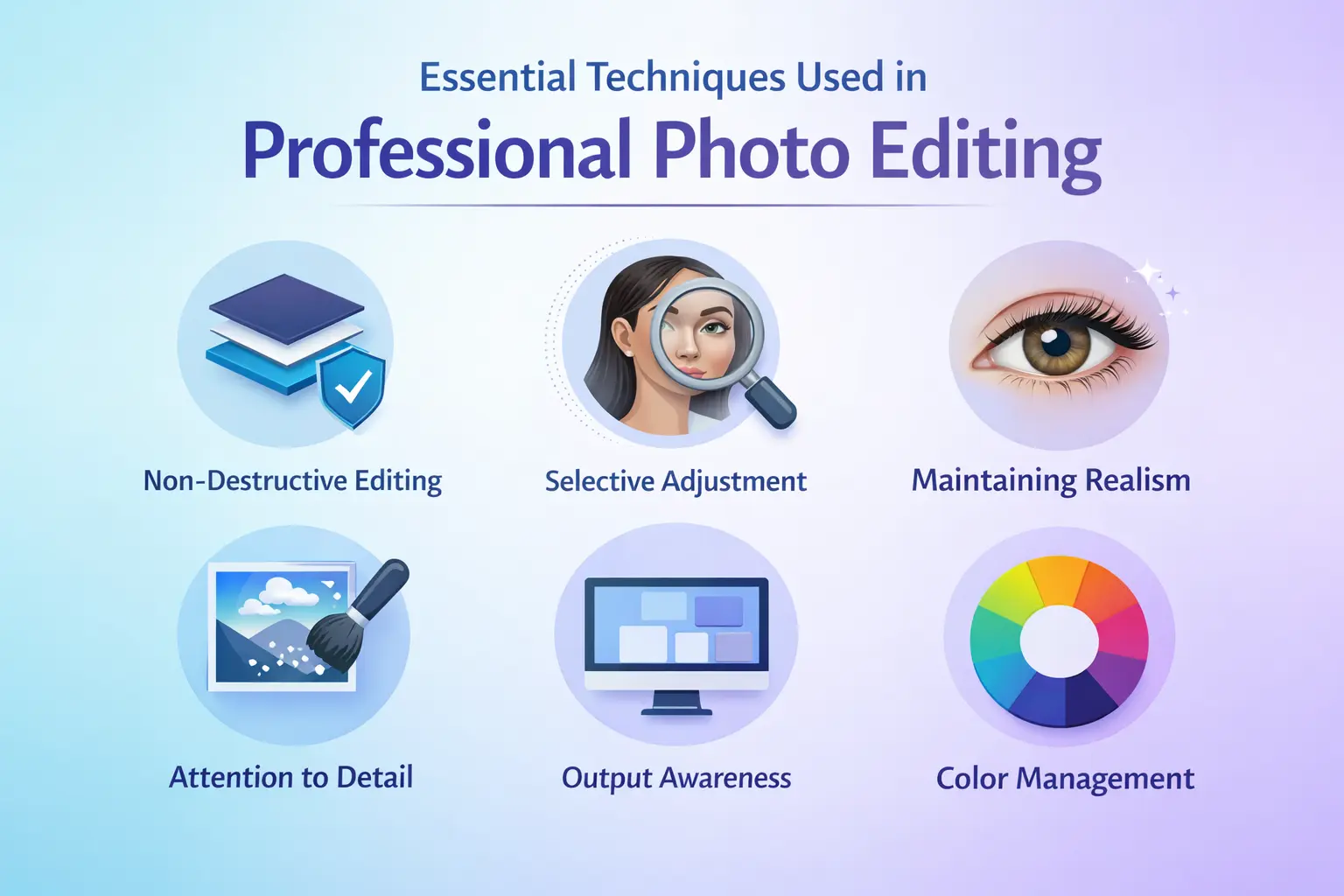
Professional editors use many techniques, but several core practices define quality work.
First is non-destructive editing. This means making adjustments in a way that preserves the original file. It allows flexibility, better revision control, and safer workflows.
Second is selective adjustment. Instead of editing the whole image equally, professionals often edit only the areas that need it. This results in more natural and precise outcomes.
Third is maintaining realism. Good editing improves an image without making it look fake unless a creative concept specifically requires stylization. Realism is especially important in portrait, product, food, and real estate photography.
Fourth is attention to detail. High-level editing involves zooming into imperfections, edge refinement, color consistency, dust removal, reflection control, and fine corrections that casual users may miss.
Fifth is output awareness. Professionals edit with the final use in mind. A file prepared for Amazon, a billboard, Instagram, or a luxury brochure must meet different technical and visual requirements.
Sixth is color management. Proper color handling ensures that the image looks consistent across devices and print outputs. This is essential for commercial work.
These techniques separate quick casual editing from true professional photo post-production.
Popular Photo Editing Tools and Software
Photo editing is performed using a range of software tools, each suited for different levels and workflows.
Adobe Photoshop
Adobe Photoshop is one of the most powerful and widely used photo editing programs in the world. It is ideal for retouching, compositing, manipulation, background removal, object cleanup, and detailed control. Professionals in photography, advertising, eCommerce, and design rely heavily on Photoshop.
Adobe Lightroom
Lightroom is popular for photo organization, batch editing, color correction, exposure adjustment, and workflow efficiency. Many photographers use Lightroom for handling large sets of images, especially from weddings, events, and portrait sessions.
Capture One
Capture One is known for excellent color grading, tethered shooting, and professional raw image processing. It is often used in commercial photography and studio environments.
GIMP
GIMP is a free photo editing tool that offers many advanced features. It is useful for users who need editing capabilities without subscribing to premium software.
Affinity Photo
Affinity Photo is another strong editing option with professional features and a one-time purchase model. It is popular among designers and photographers seeking a Photoshop alternative.
Mobile Editing Apps
Smartphone apps like Snapseed, Lightroom Mobile, and Photoshop Express allow users to make quick edits on the go. While not always suitable for advanced commercial production, they are useful for everyday content creation and fast improvements.
The best tool depends on the project, budget, skill level, and output requirements. However, software alone does not create quality. The editor’s skill remains the most important factor.
Photo Editing for eCommerce Success
Photo editing plays a major role in eCommerce because product visuals strongly influence online buying behavior. Since shoppers cannot examine a product physically, the product image becomes the main source of trust and information.
A strong eCommerce image should be clean, sharp, consistent, and visually accurate. Background removal is often the first step because most online marketplaces and branded stores prefer distraction-free product presentation. A white or transparent background keeps attention on the item itself.
Clipping path and masking help isolate the product cleanly. Retouching removes dust, wrinkles, scratches, labels, or reflections that reduce visual appeal. Color correction ensures the product looks true to life. Shadow creation adds realism so the product does not appear flat.
Consistency is especially important in eCommerce. If one product image is dark, another is bright, one is warm-toned, and another is cool-toned, the store will look unprofessional. Editing creates a cohesive visual catalog that strengthens brand trust.
High-quality edited images can also reduce returns. If customers see the product clearly and accurately, they are less likely to feel disappointed when it arrives. This improves satisfaction and operational efficiency.
For online sellers, photo editing is not just a cosmetic task. It is part of conversion optimization.
Photo Editing for Branding and Marketing
Brand perception is deeply connected to visual presentation. Every image a brand publishes contributes to how it is perceived in the market. Photo editing helps shape that perception.
A luxury brand may prefer refined highlights, muted tones, elegant retouching, and high-end cleanliness. A youth fashion brand may prefer vibrant contrast and energetic color. A natural skincare brand may prefer soft light and realistic texture. Editing helps express these identities consistently.
In marketing, edited images support campaigns by increasing appeal and message clarity. A product advertisement needs to capture attention quickly. A social media post needs to stop scrolling. A website hero image needs to communicate professionalism instantly. Editing helps make each of these visuals more effective.
Campaign visuals often require multiple adaptations across platforms. The same base photo may be resized for banners, stories, thumbnails, print ads, landing pages, and email campaigns. Editing ensures quality and consistency across all of them.
Professional brands understand that image editing is not separate from marketing. It is part of marketing execution.
Common Challenges in Photo Editing
Although photo editing offers many advantages, it also comes with challenges.
One challenge is over-editing. When images are pushed too far, they can lose realism and credibility. Skin may look plastic, colors may become unnatural, and products may appear misleading. Good editing improves without damaging authenticity.
Another challenge is inconsistency. If multiple editors work on the same project without shared guidelines, the final images may not match. Maintaining visual standards is crucial for businesses.
Time pressure is also common. High-quality editing takes patience, especially when dealing with complex edges, detailed retouching, or large batches of product images. Rushed work can reduce precision.
File quality is another issue. Poor source images limit editing potential. If a photo is blurry, low resolution, severely overexposed, or badly composed, editing can only improve it to a certain extent.
Technical skill gaps can also affect results. Professional editing requires knowledge of software, workflow, color, composition, and image output. Without that skill, edits may look amateur.
These challenges show why professional photo editing is a specialized service rather than a simple automatic process.
Best Practices for High-Quality Photo Editing
There are several best practices that define quality in professional photo editing. Start with the best possible original image. Good photography and good editing work together. Editing should enhance quality, not rescue completely poor capture when avoidable. Keep the purpose of the image clear. Editing decisions should support the intended use, audience, and brand style. Use non-destructive methods whenever possible. This protects the original image and allows revisions. Correct first, stylize second. Technical issues such as exposure, white balance, and distractions should be fixed before adding creative looks. Zoom in for detail work, but also zoom out often to judge the image as a whole. This helps maintain balance. Avoid heavy-handed retouching unless the project specifically requires it. Natural results are often more credible and appealing. Maintain consistency across a batch. Product sets, team portraits, social media campaigns, and catalogs should look unified. Export correctly for the final platform. File format, size, color profile, and compression all matter. These practices help produce edited images that are polished, functional, and professional.
The Role of Human Skill in Photo Editing
Even though editing software is powerful, human skill remains the most important part of photo editing. Software provides tools, but the editor decides how and when to use them.
A skilled editor understands composition, lighting, color relationships, brand tone, realism, and visual priorities. They know which flaws to remove, which textures to preserve, and which adjustments will strengthen the image without damaging it.
Professional judgment is especially important in retouching. For example, removing every line and pore from a face may technically smooth the skin, but it can also remove personality and realism. A good editor knows how to refine without erasing character.
The same applies to product editing. An editor must know how to make a product look attractive while still being truthful. Over-editing a product image can create false expectations and hurt customer trust.
Ultimately, photo editing is both an art and a discipline. Tools matter, but taste, precision, and experience matter more.
The Future of Photo Editing
Photo editing continues to evolve as technology advances. Artificial intelligence now helps automate tasks such as background removal, object detection, skin smoothing, and exposure balancing. These tools can save time and make basic editing more accessible.
However, AI does not replace professional judgment. In commercial work, brand consistency, fine detail, realism, and creative control still require human oversight. Automated tools can assist, but they do not fully replace expert editors for high-end results.
The future of photo editing will likely combine faster automation with deeper human refinement. Editors who understand both technology and visual standards will remain highly valuable.
As businesses continue to rely on images for marketing and sales, the demand for polished visuals will remain strong. This means photo editing will continue to be a core part of digital communication and commercial presentation.
Why Businesses Should Invest in Professional Photo Editing
Many businesses underestimate how much visual quality affects customer behavior. They may invest heavily in products, packaging, websites, and advertising, but overlook the quality of their images. This is a mistake because images often represent the business before any conversation happens.
Professional photo editing helps businesses look organized, premium, and trustworthy. It strengthens online presence, improves user experience, and supports better brand storytelling. It also increases the value of photography by ensuring the final output is ready for marketing use.
For businesses selling products online, quality editing can directly influence revenue. For service businesses, it can improve credibility. For creative brands, it can define identity.
In a competitive market, visual quality is not a minor detail. It is part of business performance.
Frequently Asked Questions About Photo Editing
Is photo editing the same as using filters?
No. Filters are only one small and simple form of adjustment. Professional photo editing includes detailed correction, retouching, color balancing, object removal, masking, resizing, compositing, and many other techniques.
Is photo editing necessary for every photo?
Not every photo needs heavy editing, but most professional images benefit from at least some basic correction. Even a strong photo may need slight exposure, crop, or color adjustments.
Can photo editing make a bad photo perfect?
Editing can improve many problems, but it cannot fix everything. Extremely blurry, low-resolution, or poorly composed images have limits. The best results come from combining good photography with good editing.
Is photo editing only for professionals?
No. Anyone can edit photos at a basic level. However, professional-quality editing requires experience, software knowledge, and visual judgment.
Why is photo editing important for online stores?
Because product images strongly influence buying decisions. Clean, sharp, and consistent images help customers trust the product and the brand.
What is the difference between clipping path and masking?
Clipping path is best for objects with hard edges. Masking is better for soft or complex edges such as hair, fur, fabric transparency, or smoke.
Does photo editing reduce authenticity?
Not necessarily. Good editing often improves authenticity by correcting camera limitations and removing distractions. Misleading editing is different from professional enhancement.
Final Thoughts
Photo editing is far more than a technical afterthought. It is a powerful process that improves image quality, strengthens communication, supports branding, and increases professional value. From simple brightness correction to advanced retouching and commercial post-production, photo editing helps transform raw images into polished visual assets.
In a world where visual content drives attention, trust, and conversion, strong image presentation matters deeply. Whether you are a photographer, online seller, brand owner, designer, marketer, agency, or everyday content creator, understanding photo editing gives you a significant advantage.
A professionally edited photo is not just nicer to look at. It is more effective, more persuasive, and more aligned with its purpose. That is why photo editing remains an essential part of modern photography and digital communication.
If the goal is to present images at their best, photo editing is not optional. It is essential.
Photo editing is the professional process of improving and refining images for better quality, stronger presentation, and higher impact. Whether used for eCommerce, branding, portraits, real estate, marketing, or personal photography, photo editing helps images look cleaner, sharper, and more effective. In the modern visual marketplace, high-quality photo editing is one of the most valuable tools for creating trust, attracting attention, and presenting images professionally.