In the modern digital marketplace, visual content has become one of the most powerful tools for influencing consumer decisions. Studies consistently show that customers form trust judgments within seconds of viewing a product image. As a result, businesses can no longer rely on average-quality photographs; they must present images that are clean, precise, and visually compelling.
Photoshop clipping path service plays a foundational role in achieving this level of professionalism. It allows businesses to isolate products from distracting backgrounds, ensuring that the focus remains entirely on the subject. Whether the image is intended for an e-commerce listing, a printed catalog, or a digital advertisement, clipping paths ensure visual clarity and brand consistency.
This guide is written to serve as a complete professional resource on Photoshop clipping path services. It explains not only the technical process but also the business value, industry applications, SEO implications, and future relevance of clipping path services in a competitive digital environment.
What Is a Clipping Path in Photoshop?
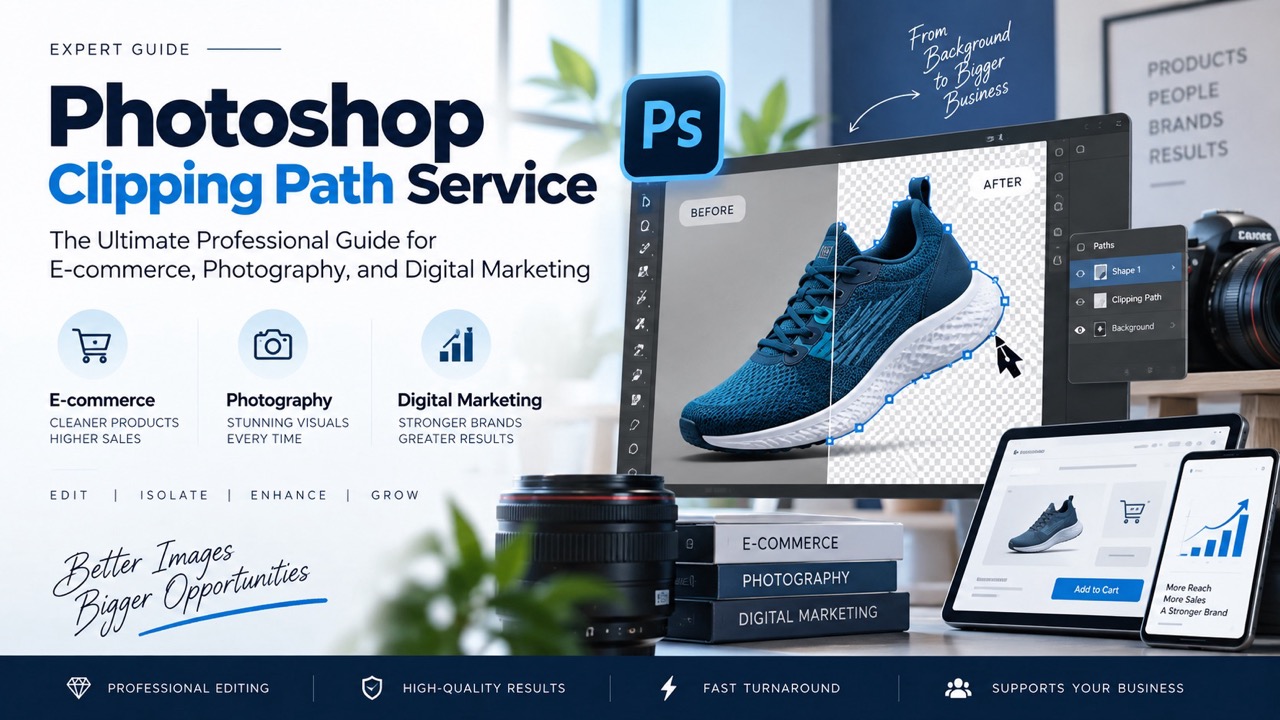
A clipping path is a closed vector path created around an object using Adobe Photoshop’s Pen Tool. This path defines the visible area of the object and allows everything outside the path to be removed or hidden without damaging the original image.
Unlike raster-based selections, clipping paths are resolution-independent. This means the edges remain sharp and clean whether the image is used for web display or large-format print. Because of this accuracy, clipping paths are widely used in professional image editing workflows where quality cannot be compromised.
From a technical perspective, clipping paths are especially effective for objects with well-defined edges. They provide a level of control that automated tools and quick selection methods cannot consistently deliver, particularly in commercial and high-volume production environments.
Why Photoshop Clipping Path Service Is Still Essential in 2026
Despite rapid advancements in artificial intelligence and automated image-editing software, Photoshop clipping path services remain highly relevant. Automation can speed up basic tasks, but it still lacks the judgment, consistency, and edge accuracy required for professional commercial use.
Many AI-based tools struggle with reflective surfaces, overlapping objects, internal cutouts, and subtle curves. In contrast, a skilled human editor can evaluate the image context, adjust anchor points manually, and ensure that every edge looks natural and precise.
In 2026, the demand for premium visuals has increased rather than decreased. Marketplaces have become stricter, customers are more visually educated, and brands compete heavily on presentation. Manual clipping path services continue to be the safest and most reliable solution for businesses that prioritize image quality.
Industries That Rely Heavily on Clipping Path Services
E-commerce Businesses
E-commerce platforms rely almost entirely on images to communicate product value. Customers cannot touch or examine products physically, so the image must represent the product accurately and attractively.
Clipping path services help e-commerce businesses maintain uniform backgrounds, highlight product details, and meet marketplace image guidelines. This consistency builds trust, reduces returns, and improves conversion rates.
Professional Photography Studios
Photography studios use clipping paths as part of their post-production workflow. Raw images often contain unwanted backgrounds, props, or studio elements that must be removed before delivery.
By applying precise clipping paths, photographers can offer clean, polished images to clients, ensuring professional presentation across albums, advertisements, and online portfolios.
Digital Marketing Agencies
Marketing agencies depend on visual consistency across campaigns. Whether creating banner ads, social media creatives, or landing pages, they require images that can be easily placed into different layouts.
Clipping paths allow marketers to reuse the same subject across multiple backgrounds and formats, saving time while maintaining visual coherence.
Print and Publishing Industry
In print media, image quality standards are extremely high. Even minor edge imperfections can become noticeable when printed at large sizes.
Clipping path services ensure smooth edges, clean separations, and flawless integration into layouts such as catalogs, brochures, magazines, and billboards.
Types of Photoshop Clipping Path Services
Basic Clipping Path
Basic clipping paths are used for objects with simple shapes and minimal curves. These paths require fewer anchor points and can be completed quickly while maintaining accuracy.
They are commonly applied to products like boxes, books, electronics, and other geometric items where the edges are mostly straight.
Simple Clipping Path
Simple clipping paths involve slightly more complexity, including curved edges and moderate detailing. These paths require more careful anchor placement to preserve smooth contours.
Products such as shoes, bottles, kitchenware, and basic furniture often fall into this category.
Complex Clipping Path
Complex clipping paths are required for objects with multiple curves, holes, and overlapping parts. These images demand advanced skill and significant time investment.
Examples include jewelry, bicycles, machinery parts, and decorative objects with intricate designs.
Super Complex Clipping Path
Super complex clipping paths are the most challenging and labor-intensive. They involve hundreds or even thousands of anchor points.
These are typically used for industrial equipment, complex furniture designs, or objects with extreme structural detail where absolute precision is required.
Clipping Path vs Image Masking: Understanding the Difference
Clipping path and image masking are often confused, but they serve different purposes. Clipping paths are best suited for hard-edged objects, while image masking excels at handling soft, semi-transparent areas.
Image masking uses layer masks or channels to preserve fine details like hair, fur, smoke, or transparent materials. In many professional workflows, both techniques are combined to achieve optimal results.
Understanding when to use clipping paths and when to apply masking is a key indicator of a truly professional image editing service.
The Professional Clipping Path Workflow
A professional clipping path service provider workflow begins with image analysis. Editors examine object complexity, edge type, shadow requirements, and final usage before choosing the appropriate approach.
The next step involves manually creating the path using the Pen Tool. Skilled editors strategically place anchor points to ensure smooth curves and natural edges without unnecessary complexity.
After path creation, refinement is performed at high zoom levels to eliminate irregularities. Finally, quality control ensures that the image meets client specifications and industry standards before delivery.
Marketplace Requirements and Clipping Path Compliance
Online marketplaces enforce strict image guidelines to maintain platform quality. Amazon, for example, requires pure white backgrounds, accurate color representation, and clean edges.
Failure to comply with these requirements can result in listing rejection or suppression. Professional clipping path services ensure that images meet all technical specifications, reducing the risk of penalties.
For sellers managing large catalogs, consistent compliance is only achievable through reliable, professional image editing workflows.
Common Mistakes in Low-Quality Clipping Path Services
Low-quality services often rely heavily on automation, resulting in jagged edges, missing cutouts, and unnatural shapes. Excessive anchor points can also cause uneven curves and visible distortions.
Such mistakes not only reduce visual appeal but also damage brand credibility. In competitive markets, even small imperfections can influence purchasing decisions negatively.
Choosing a professional service provider helps avoid these costly errors.
Pricing Models for Clipping Path Services
Clipping path pricing is typically based on complexity, turnaround time, and volume. Simple images cost less, while complex or super complex paths require higher investment.
Professional providers often offer bulk discounts or monthly packages for agencies and e-commerce businesses. Transparent pricing reflects confidence in quality and service reliability.
Extremely low prices usually indicate automated processing, which rarely meets professional standards.
How to Choose the Right Clipping Path Service Provider
Selecting the right provider requires careful evaluation. Look for companies that guarantee manual editing, provide sample work, and maintain strict quality control processes.
Reliable communication, data security, and consistent turnaround times are equally important. A professional provider acts as a long-term partner rather than a one-time vendor.
Turnaround Time Expectations
Turnaround time varies depending on complexity and order volume. Basic images may be completed within hours, while complex projects may require several days.
Professional studios balance speed with accuracy, ensuring that deadlines are met without compromising quality. Clear timelines are a hallmark of dependable service providers.
Why Outsourcing Clipping Path Services Makes Business Sense
Outsourcing eliminates the need for in-house editing teams, reducing operational costs. Businesses gain access to specialized expertise without investing in training or software infrastructure.
It also allows companies to scale image production quickly during peak seasons while focusing internal resources on core business activities.
Future of Clipping Path Services
The future of clipping path services lies in hybrid workflows where AI assists with preliminary selections and human experts handle refinement and quality assurance.
High-end brands, print production, and export-grade visuals will continue to rely on manual precision. As visual standards rise, professional clipping path services will remain indispensable.
Photoshop clipping path service is a critical component of professional visual communication. It ensures accuracy, consistency, and adaptability across digital and print platforms. Businesses that invest in high-quality clipping path services gain a competitive advantage through better presentation, stronger branding, and improved customer trust. In a visually driven marketplace, precision is not optional. It is the foundation of professional success.